


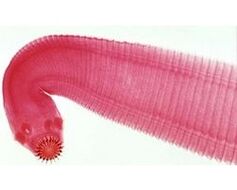
Different types of worms are found everywhere, children make up 80% of the victims.Helminths or worms (from the Greek parasite worm) are lower worms that parasitize the human and animal body.They cause pathologies called helminthiasis.According to the World Health Organization, 50% of the population is infected every year: pinworms (1.2 billion people), worms (900 million) and whipworm (up to 700 million).
What kinds of worms are there?To date, more than 400 species of worms found in humans have been identified.In humans, all types of worms are divided into 2 large groups: flatworms and roundworms (nematodes).In turn, flatworms are divided into tapeworms (cestodes) and flukes (trematodes).Cestodes are also divided into tapeworms and tapeworms.
The idea that worms in humans live only in the intestines is a misconception;They can circulate blood throughout the body and settle in different places.All types of parasitic worms feed on the host and use it for their life cycle.
Circulation of worms in nature
To maintain their species, parasites must constantly move to the external environment, leave their host and settle in the body of animals, using them as intermediate hosts.Carriers are of great importance in this process: mechanical - these can be insects that carry worms on their legs over distances.Worms do not live in the body of insects.
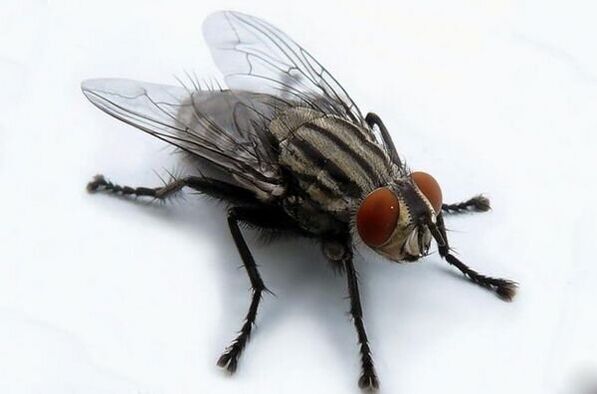
Specific carrier or intermediate host - in which the parasites go through only one cycle of development.In circulation, the method of transmission of worms is important:
- contact - penetration through intact skin and mucous membranes (hokchiya);
- food.
Peculiarities of reproduction of worms
Most of the lower worms are hermaphrodites, but there are also worms with gender differences - nematodes.If helminths change several hosts during their development cycle (sometimes up to 4), they are called biohelminths.If they live with only one owner, they are geohelminths.
Stages of development of worms:
- Egg Stages - The female lays immature eggs, which mature in the external environment and are then returned orally to humans.
- The second stage is the hatching of the larva from the egg.This process takes place in the gastrointestinal tract.It migrates throughout the body, looking for an ideal habitat.After its discovery, it continues to develop into an adult.
- The third stage is the adult, which lays eggs again.It should be noted that worms do not develop in all organisms, but only in suitable ones, that is, for example, larvae whose host is an ungulate will survive if they enter the body of the prey, but do not lay eggs there.
Types of helminths
Types of helminths in humans are divided according to their habitat: lumen and tissue.In the first case, parasites live in the lumen of hollow organs, most often the intestines: ascaridosis, trichuriasis, strongyloidosis, taeniarhynchiasis and others.Tissues live in the thickness of various organs and tissues.What organs can be affected by worms?They can settle and affect the hepatobiliary system, brain, eyes, lymph nodes, lungs, so the diseases can have several names:
- for liver damage - echinococcosis;
- brain damage - cysticercosis;
- Lymph nodes - filariasis;
- Pulmonary helminthosis - paragonimiasis;
- Tissue helminthosis - under the name of worms: trichinosis, schistosomiasis, filariasis, toxocariasis.
- Ophthalmic helminthic infections - when parasites affect the eyes and more pronounced pathological changes are caused by the larvae and developmental stages of worms.
habitat
Parasitic worms are found from the Arctic to the equator, but those worms that are characteristic of the tropics will not be diagnosed in residents of northern latitudes.The degree of infection of the population with helminthic infections depends on the country's economic level and climate.The most common types of worms are hookworms, roundworms, and pinworms.The source of infection is the organism - the final host.

Ways of infection with worms:
- The feeding route is eating unwashed or fly-infested food, insufficient heat treatment of meat, eating raw fish, drinking boiled water, swallowing water while swimming in reservoirs, using the same knife for raw and cooked food.
- Fecal-oral transmission: contaminated household items, unwashed hands after using the toilet, contact with animals.
- way of transmission.Transmission by insect bites.
Infection from pets
You can be infected with tapeworms, echinococcus, roundworm and pigworm through contact with a dog.Worm eggs can be on the dog's fur, and besides, these animals have a habit of eating other people's feces while walking.From cats: the same as in dogs, as well as cat worms, from chickens - roundworms, from humans - pinworms, dwarf and pig tapeworms, hookworms.
How do worms affect the body?
Parasites sensitize the body with their waste products, toxins and enzymes, resulting in:
- allergy and intoxication;
- mechanical damage to mucous membranes with suction cups and hooks;
- Large worms can block the intestinal lumen.
- In addition, worms eat a significant part of the incoming BZHU, which causes anemia, vitamin and microelement deficiency, hypoxia, malnutrition;
- There are digestive disorders, children have delays in psychophysical development.
- With many helminthiasis, chronic microblood loss occurs.
- Helminths worsen the course of existing pathologies, suppress the immune system, increase the risk of tuberculosis and cancer, and reduce the effectiveness of vaccination.
Characteristics of the most common worms
What do roundworms look like?When cut, they have a round shape, which is why they got their name.Roundworms have their own characteristics.First of all, it is their extraordinary durability: they survive in formaldehyde for 5 years.In addition, they are characterized by a simple development cycle, a digestive system in the form of a straight tube, and rapid reproduction.
Worms cause enterobiasis (anthroponotic disease, dirty hands disease).They look like small white worms up to 1 cm (male only 3 mm), the end of the body is slightly pointed.They live in the lower part of the small intestine and the beginning of the large intestine.They are contact worms.Eggs are laid in the anus area.The development cycle lasts 2 weeks, they live 1-2 months.It is more common in children.They are attached to the intestinal wall using their vesicles.Female pinworms descend towards the anus in the evenings and lay eggs there.At the same time, they secrete a special type of liquid that causes itching.The child scratches the bottom and self-infection occurs.Females die after laying eggs.The damage they cause is the release of enzymes that irritate the intestinal walls and contribute to their inflammation.
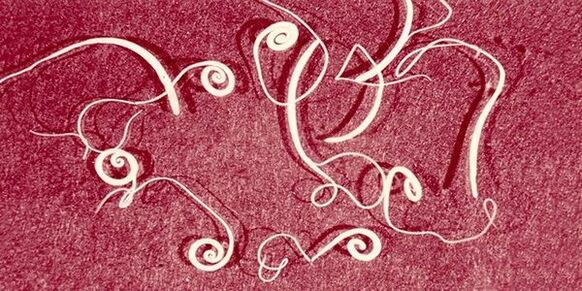
Roundworms cause ascariasis.These are reddish-white roundworms up to 50 cm long and 6 cm wide.Males have a curved end.Roundworms live in the small intestine, but the larvae actively migrate throughout the body, their life cycle reaches one year.Worm larvae live in the lungs.Their residues cause intoxication and intestinal obstruction.
Parasites are geohelminths, that is, they develop in the soil and from there they are transmitted to humans.They are distinguished by enormous fertility, up to 240 thousand eggs per day.The eggs have a very strong three-layered shell and fall easily into the ground.Here, under the influence of oxygen, moisture and a certain temperature, larvae are formed in them.This process can last from 2 weeks to several months, depending on the temperature.Such a mature egg together with the larva again enters a person orally.The larva appears in the intestines and travels throughout the body through the bloodstream.Its favorite habitat is the alveoli of the lungs, because there is access to oxygen and the larva is aerobic.Adults are anaerobes.After reaching a length of 3-4 mm, after 4-5 days the larva moves into the bronchi, which causes coughing.During coughing, it is swallowed and returned to the intestines, where it develops to maturity.The life cycle of the parasite reaches one year.
Whipworm causes trichuria, belongs to nematodes, has a grayish to reddish color, reaches 2-5 cm, has a sharp hair-like tip, hence the name.The parasite adheres to the intestinal wall and feeds on the blood and mucous tissues of the host.Lives in the large intestine and appendix, where the larvae reach sexual maturity and lay 3.5 thousand eggs daily.The life cycle of the parasite is 4-5 years.By damaging the intestinal wall, they contribute to its damage: it causes appendicitis, diarrhea, abdominal pain, anemia.Helminth eggs enter the soil through human feces, where they can last up to 2 years.
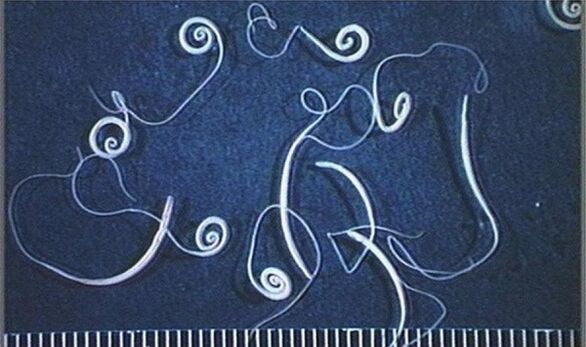
Toxocariasis causes toxocariasis.It is a yellowish worm that looks like a roundworm but is 15-20 cm long.This is a biohelminth;People get infected from dogs.They live in the form of eggs.Larvae emerge from them in the human intestine.They migrate throughout the body, damage internal organs and cause allergies.The severity of the clinic depends on immunity and the number of helminths.Laying eggs per day - up to 250 thousand.Life cycle - up to 10 years.
Trichinella spiralis causes trichinosis, which is considered the most dangerous helminthiasis because it often ends in death.The length of the nematode is only 5 mm.Infection occurs when eating poorly cooked pork.Trichinella is fertilized in the intestine, the larvae become pregnant and hatch inside the female.At one end, the female attaches to the intestinal wall and throws up to 2,000 live larvae.This process is called ovulation and lasts 3-4 days.Larvae are carried in the bloodstream and settle in striated muscles, especially the masticatory, oculomotor, respiratory and shoulder flexors.The disease is severe: pain in the abdomen, muscles, head and joints, fever, swelling of the face and intoxication appear 2 weeks after the attack.In the muscles, after a month, the larvae coil in the form of a spiral and can remain in a cyst-like state for 20 years without losing viability.After 1.5 months, recovery occurs with proper treatment.
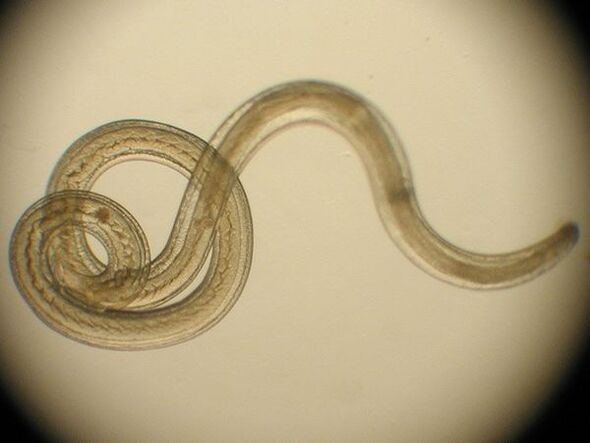
Hookworm and nekator are similar to each other, so their helminthosis is given the common name - worm.Their length is up to 1.5 cm and they parasitize the duodenum.Helminths are common, but rarely detected.Larvae can penetrate the skin on contact with soil.The development cycle is very similar to roundworms.The hookworm lives in the intestines and feeds only on blood.One person can absorb 0.35 ml of blood per day.Therefore, anemia and dysproteinemia are characteristic features.
Flatworms have a flattened shape.They have no gender differences;They are hermaphrodites.They are attached to the intestines using hooks and suction cups.
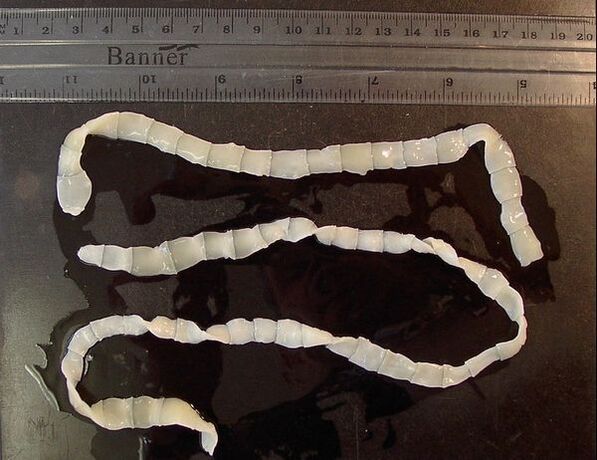
Bull tapeworm is the tapeworm that causes taeniarhynchiasis.It has a small head with 4 suction cups and 6 hooks and a 1000-segment tape, with a length of up to 20 m.The parasite is a biohelminth, the infection occurs through beef, where its larvae are located.Each segment contains hundreds of thousands of eggs.Without treatment, tapeworms parasitize people for up to 20 years.It lives in the small intestine, absorbing nutrients from the entire surface of the body.lives up to 10 years.
Bovine tapeworm is a tapeworm that causes taenia or cysticercosis.It reaches 3-8 m and has a double ring of hooks.The life cycle is 20 to 30 years.It can live in any organ and is found in poorly cooked pork.The cycle is similar to the Bulgarian tapeworm.These tapeworm segments can exit the anus, where they burst onto the surface of the skin and release the eggs.Helminth parasitizes the intestines, causes allergies and gastrointestinal problems.
A wide band causes diphyllobothriasis.The length of the parasite is more than 10 m, it is flat and wide.Biohelminths reach humans through freshwater fish or crustaceans.For dozens of years, worms parasitize in the small intestine, clinging to its wall.In 25 days, the parasites grow into adults.They feed on blood, causing diarrhea and abdominal pain.
Echinococcus is a biohelminth, a small ribbon, up to 3-5 mm.2 crowns of hooks and suction cups are depicted on the head;The parasite has 4-5 segments.The last is its reproductive system.In organs, it forms up to 10 cm cysts (fins), where eggs and larvae are located.The cyst destroys the surrounding tissue.They can burst, then toxic shock or many new cysts develop.The ultimate host is the wolf, and the intermediate host is the human.Infection after contact with food or pets.Larvae (oncospheres) emerge from the eggs in the intestine and are carried throughout the body by blood circulation.They settle, as a rule, in the parenchyma of the liver and lungs, but also live in the intestines.Cysts can only be removed surgically.
Cat fluke is liver fluke, cat fluke, or Siberian fluke.causes opisthorchiasis.It has a lanceolate shape, 1-2 cm long and 2 mm wide, with 2 oral suckers on the head.Humans are infected by freshwater fish that have eaten snails or crustacean worm eggs.Man is the main host.The parasite lives in the lumen of the small intestine and bile ducts.The life cycle is up to 20 years;Thousands of individuals are simultaneously parasitized in one organism.The acute phase of the disease is characterized by pain in the upper abdomen, fever, nausea, myalgia, diarrhea and rash.When the process becomes chronic, the symptoms of hepatocholecystitis are observed, which do not disappear even after the worms are removed.
Disease course and symptoms
In the acute phase, symptoms can appear at different times, depending on the incubation period, but most often begin after 2-3 weeks.The most common symptoms: allergic rash, lymphadenopathy, development of local or general edema, arthralgia and myalgia.When migrating to the lungs, there may be coughing, choking attacks, stool disorders (diarrhea), nausea and vomiting.
In the chronic phase, the symptoms depend on the organ where the parasites settled and their number.Key features include:
- frequent itching in the anal area;
- headache
- dizziness;
- sleep disturbance;
- Flatulence
- rash and itching;
- Fatigue due to increased appetite;
- joint and muscle pain;
- yellowing of the skin;
- tiredness
- A low-grade fever may persist;
- discomfort in the navel area or in the right hypochondrium;
- periodic nausea and vomiting;
- bruxism;
- Apathy.
The patient has pale, dry skin, hair loss, eyebrows, eyelashes, brittle nails, tooth decay, bleeding gums, and bad breath.
Diagnostic measures and prevention
To determine the diagnosis, a scraping is made from the rectum and perianal area, and a stool analysis is also performed.In this case, the worms are very clearly visible under the microscope.A blood test is taken for the balance of eosinophils and proteins.It is possible to examine the contents of the sputum, stomach and duodenum.
Any helminths in humans are prevented by constant personal and public hygiene, sufficient heat treatment of meat and fish.Regular veterinary examinations and follow-up treatment of all pets are essential.